
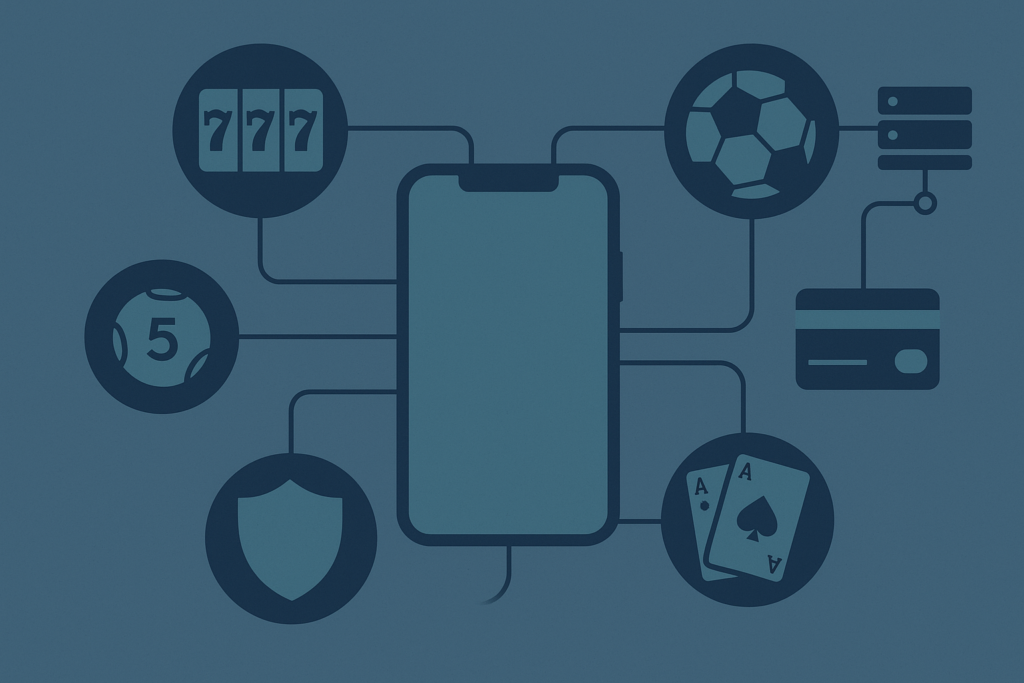
iGaming is the business of wagering real money on games and events over the internet: online casino games, sports betting, poker, lottery and bingo, all delivered through websites and apps rather than a physical venue. The “i” stands for interactive, and that word does a lot of work. It signals two-way, real-time play on a connected device, with outcomes, money movement and player records handled by software.
If you’re new to the sector, this guide covers what iGaming means, the four main verticals, the technology stack that makes them work, and who does what across the ecosystem.
What does iGaming mean? (definition and scope)
iGaming means placing real-money wagers through internet-connected devices, where a licensed operator runs the game or accepts the bet and settles it digitally. That’s the whole definition. Everything else is detail about vertical, jurisdiction and delivery.
The difference from traditional gambling isn’t the activity, it’s the delivery. A blackjack hand is a blackjack hand whether it’s dealt on felt in Atlantic City or by a dealer on camera in a Philadelphia studio. What changes online is that every action is logged, the pace is set by software, the player is verified electronically, and geolocation decides whether the bet is even allowed.
Two points of confusion come up constantly. First, “gaming” in American business usage has long meant gambling, not video games. The American Gaming Association represents casinos, not console publishers. iGaming inherits that usage, which is why the term catches newcomers off guard. Second, plenty of adjacent products look like iGaming but sit outside it legally: social casino apps where you buy virtual chips and can never cash out, and sweepstakes-model casinos that use a promotional entry structure to operate in states without licensed online casino gaming. Neither is regulated as gambling in the same way, and mixing them up will get you into trouble in a business plan.
The four main iGaming types
The industry splits into four verticals, each with its own economics, regulation and player behavior. In the US, they’re legal in very different footprints.
Online casino games (slots, table games, live dealer)
Online casino, often called iCasino, covers slots, digital table games and live dealer play. Slots are the volume driver: server-side software determines each spin, and games publish a theoretical RTP (return to player), typically in the mid-90s. A 96% RTP means the game returns about $96 per $100 wagered averaged across millions of rounds, leaving a 4% house edge. That average says nothing about any single session.
Digital table games run the same way, with published house edges instead of RTP: European roulette with a single zero carries a 2.7% edge, American roulette with the double zero carries 5.26%. Live dealer sits in between the two worlds, with a real dealer streamed from a studio and bets placed through an interface.
US context: licensed online casino gaming exists in only a small group of states, including New Jersey, Pennsylvania, Michigan, West Virginia, Connecticut, Delaware and Rhode Island. It’s the highest-revenue-per-player vertical in those markets and the slowest to expand legislatively.
Sports betting and daily fantasy sports
Sports betting is the vertical that opened the US market. After the Supreme Court struck down the federal ban in Murphy v. NCAA in May 2018, states became free to legalize, and most have. Online sportsbooks offer pre-match markets, live in-play betting, parlays and player props, and they make money through the margin baked into the prices, the reason a standard point spread is priced at -110 on both sides rather than even money.
Daily fantasy sports (DFS) sits alongside it. Players draft rosters and win based on real athletes’ statistics, and operators have historically argued DFS is a game of skill rather than a wager. State treatment varies, and some regulators have pushed DFS-style products toward sports betting rules.
Online poker and tournament play
Poker is structurally different from the rest: players compete against each other, not the house. The operator takes a rake, a small cut of each pot or a tournament entry fee, which means revenue scales with the number of active players rather than with a built-in edge.
That makes liquidity everything. A poker room with thin traffic can’t fill tables, which is why state-by-state licensing hurts poker more than any other vertical, and why a multi-state agreement exists to let some regulated states share player pools. Legal online poker is live in a handful of states, including Nevada, New Jersey, Pennsylvania, Michigan and Delaware.
Digital lottery and bingo
State lotteries were among the first to sell online, through iLottery programs offering draw-game tickets and instant-win games, plus courier services that buy physical tickets on a customer’s behalf in some states. Because lotteries are state-run, the business model is public revenue rather than commercial licensing, and the politics are different.
Online bingo is a much smaller US category than it is in the UK, where it functions as a mainstream social product with chat rooms and community features. In the US it mostly appears as a game type inside casino lobbies rather than a standalone vertical.
Technology that powers iGaming platforms
An iGaming platform is a stack of specialized systems stitched together. At the center is the player account management system (PAM), which holds identity, wallet, bonuses and gameplay history. Games, payments, compliance tools and marketing systems all plug into it.
Random number generation (RNG) and game fairness
A random number generator produces the outcome of every slot spin, virtual card deal and roulette result. Each round is independent: there is no memory between spins, no “hot” or “cold” machine, and nothing a player does changes the underlying probability.
Fairness is a certification question, not a promise. Independent testing laboratories such as Gaming Laboratories International and BMM Testlabs review RNG output, confirm that a game’s actual return matches its stated RTP, and submit reports to regulators before a title can go live in a licensed market. In crypto-native products you’ll also see provably fair systems, where cryptographic seeds let a player verify a specific round wasn’t manipulated.
Payment processing and security
Payments are where a lot of operators quietly lose money. Real-money gaming carries elevated fraud and chargeback exposure, and card issuers sometimes decline gambling transactions outright, so operators run several rails at once: debit cards, ACH bank transfers, PayPal, branded prepaid cards and cash deposits at partner casino cages.
Wrapped around payments is compliance infrastructure. KYC checks verify identity and age before withdrawal, anti-money-laundering monitoring flags unusual patterns, and geolocation services confirm the player is physically inside a state that permits the bet, at the moment they place it. Geolocation is a hard legal requirement, not a nice-to-have, and it’s one of the clearest technical differences between online and land-based operations.
Live streaming and real-time gaming
Live dealer games run out of purpose-built studios with multiple camera angles, low latency video and optical character recognition that reads the physical cards or wheel result and pushes it into the game logic. The engineering problem is synchronization: the video feed, the betting window and the settlement all have to line up for thousands of concurrent players.
Mobile delivery matters just as much. Most regulated-market traffic arrives on phones, so games are built in HTML5 to run in a browser or inside a native app, and app store policies for real-money gambling add another distribution constraint operators have to plan around.
Who operates in the iGaming industry
The ecosystem divides into distinct business roles, and most companies occupy one or two of them rather than the whole chain.
- Operators hold the consumer-facing license and the customer relationship: online casinos, sportsbooks and poker rooms. In several US states they must partner with a land-based casino to get market access.
- Platform providers supply the PAM, wallet, bonus engine and reporting layer that an operator runs its business on.
- Game studios and content aggregators build slots, table games and live dealer content. Aggregators bundle hundreds of titles from many studios into a single integration.
- Payment processors and geolocation vendors move money and enforce jurisdictional boundaries.
- Affiliates and media send traffic to operators for commission, usually revenue share or cost per acquisition. This is where a lot of newcomers enter the sector.
- Regulators and testing labs issue licenses, approve games and audit behavior. In the US, regulation is state-level, through bodies such as the New Jersey Division of Gaming Enforcement, the Pennsylvania Gaming Control Board and the Michigan Gaming Control Board.
- Responsible gaming and compliance suppliers provide self-exclusion registries, affordability tools and monitoring systems.
One thing surprises people from other tech sectors: suppliers need licenses too. A game studio or payment vendor generally has to hold its own supplier or vendor registration in each state where its product is used. Regulatory compliance is a cost center for the entire chain, not just the brand on the app icon. Industry-level revenue and market-size figures for US commercial gaming are published by the American Gaming Association.
iGaming vs traditional gambling: key differences
Both involve the same wagers and the same built-in house advantage. What differs is access, oversight and the amount of data generated.
| Dimension | iGaming (online) | Land-based casino |
|---|---|---|
| Access | Any device inside a permitted state, 24/7 | Travel to a licensed property during opening hours |
| Location control | Enforced by geolocation on every session | Enforced by physical presence |
| Identity checks | Electronic KYC at signup and withdrawal | ID check at the door or cage |
| Game speed | Player-controlled; rounds can be very fast | Set by dealer or machine cycle |
| Minimum stakes | Often cents per round | Typically higher table minimums |
| Player data | Every wager, session and deposit logged | Partial, mostly via loyalty cards |
| Regulatory footprint | State-by-state licensing plus supplier approvals | Property-level licensing |
| Responsible gaming tools | Built-in deposit, loss and session limits; self-exclusion | Mostly staff-led plus self-exclusion programs |
Some concrete iGaming examples make the contrast clearer: a $0.20 slot spin taken on a phone during a lunch break, a live in-play bet placed on the next drive of an NFL game, a $10 online poker tournament with players from three states in the same player pool, or an instant-win lottery game bought from a state lottery app. None of those has a straightforward land-based equivalent.
Frequently asked questions
Is iGaming the same as gambling?
Effectively yes, when it involves real-money wagers. iGaming is the online, interactive segment of gambling. The term is used to separate internet-delivered products from land-based casino operations, not to describe a different activity.
What are the main types of iGaming?
Four: online casino games (slots, table games, live dealer), sports betting and daily fantasy sports, online poker, and digital lottery and bingo.
What technology powers iGaming platforms?
A player account management system at the core, certified RNG software for game outcomes, multiple payment rails with KYC and AML checks, geolocation to enforce state boundaries, live streaming studios for dealer games, and HTML5 for mobile delivery.
Does the house always have an edge online?
In casino games and sportsbook markets, yes. RTP and house edge are mathematical properties of the game, and over enough rounds the operator’s margin holds. Poker is the exception structurally, since the operator takes a rake and players compete against each other rather than the house.
A note on responsible gambling
Real-money gaming is entertainment with a negative expected value over time, and the always-on nature of online play makes limits more important, not less. Licensed platforms are required to offer deposit, loss and session caps, reality checks and self-exclusion, and anyone working in the sector should understand how those tools function. Minimum age is 21 in most regulated US states, 18 in a few. If gambling stops feeling like a choice, the National Problem Gambling Helpline is available at 1-800-GAMBLER.